%20(1).png)
Body, Space & Data: Inside UCL at Here East’s BodyLab

What is design without the data to back it up?
The BodyLab at Here East is the experimental playground of B-media, the spatial computing arm of UCL’s Bartlett School of Architecture. Spatial computing is an emerging discipline spanning augmented and virtual reality, motion capture and sensing, and the BodyLab gives students and staff a modern facility and the tools to explore and experiment.

The lab supports undergraduate, master’s and PhD projects as well as staff research.
"While a lot of the research and the practice that we do in the BodyLab is focused on empirical work, we do also collaborate with people that are in performance and interaction, for example. And so that might include work that we’re doing with choreographers, with dancers, with people that are in games, et cetera."
Dr Fiona Zisch, co-director of the BodyLab and Director of the International Centre for NeuroArchitecture and NeuroDesign
The lab uses marker-based and markerless tracking together, covering a multitude of applications from neuro-rehabilitation work with Queen Square Neurology to robotics and immersive storytelling.
The brief
The lab already had a motion capture system based on older technology, that had proved invaluable for precision manufacturing. The team wanted to upgrade to a solution with a much higher frame rate and a wider variety of applications. As a one-of-a-kind facility serving a school spread across four sites, it also needed to be flexible enough to support several kinds of work at once.
The challenge
The project came with tight constraints on both budget and timeline. There was also a specific requirement that all structural work to the grid be completed by a single contractor.
On top of that, the lab's use cases are often bespoke, from tracking robots to performance, so the system had to be precise and adaptable. All of this had to be coordinated across a range of stakeholders in a relatively short space of time.
The result
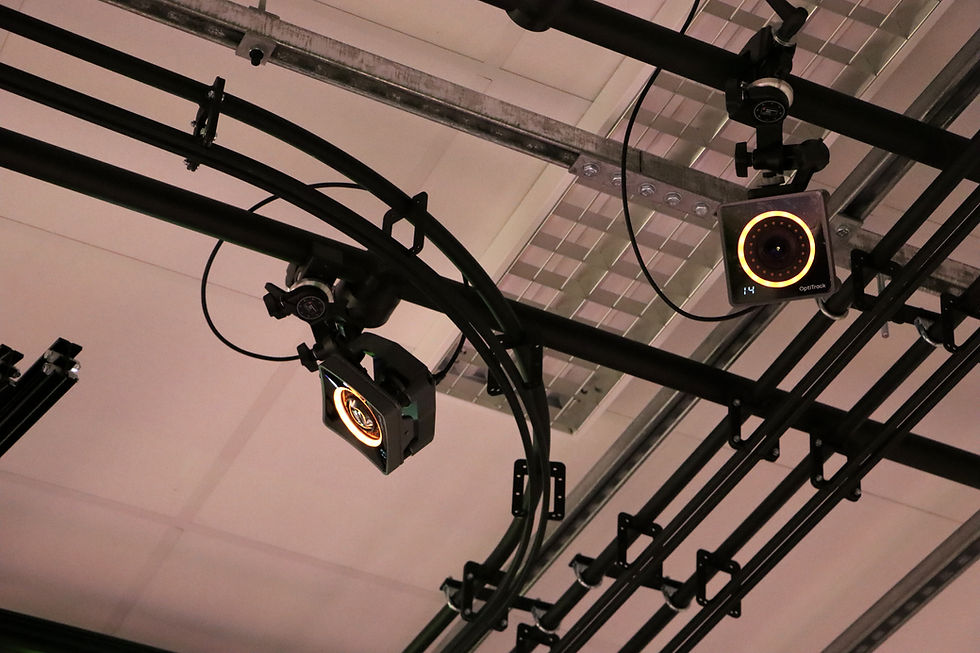
Target3D delivered a 16-camera OptiTrack system made up of eight PrimeX 22 and eight Prime 13W cameras. The combination gives the precision to capture a small marker over a long distance, plus the field of view the lab needed. With all 16 cameras running, the system achieves precision levels of 0.6mm, which suits both scientific work and performative work.
The ceiling rig is divided into two halves, each with eight cameras and its own powerful compute set, with a curtain that can be drawn down the middle. This means two tasks can run side by side, whether that's two motion capture sessions, an extended reality project, or robotics.

The feedback
"Having a partner who can navigate through all of the different requirements, all of the stakeholders who were involved within a relatively short space of time was just a massive advantage."
David Shanks, Project Lead for Computing and Online Delivery & Deputy Director
Bartlett School of Architecture, UCL
"The thing that I like about Target3D is they, along with OptiTrack, work really hard to keep us well supported even when the use cases are bespoke."
Cephas Bhaskar, Spatial Computing Technician
Bartlett School of Architecture, UCL
When it comes to designing motion capture solutions, trust the experts at Target3D. From engineering to install and support, we're with you every step of the way. Contact us today to talk about your project or request a quote.
Learn more about The BodyLab here, and stay tuned for their LinkedIn account (coming soon).


Comments